

How To Clean Mini Dv Head Without Tape
Frequently asked questions
- How tin I donate to the project?
- How practise I calculate the step_distance parameter in the printer config file?
- Where'due south my serial port?
- When the micro-controller restarts the device changes to /dev/ttyUSB1
- The "make wink" command doesn't work
- How practise I alter the serial baud rate?
- Can I run Klipper on something other than a Raspberry Pi 3?
- Can I run multiple instances of Klipper on the same host automobile?
- Practice I accept to use OctoPrint?
- Why can't I move the stepper before homing the printer?
- Why is the Z position_endstop gear up to 0.5 in the default configs?
- I converted my config from Marlin and the X/Y axes work fine, but I simply go a screeching noise when homing the Z axis
- My TMC motor driver turns off in the middle of a impress
- I continue getting random "Lost communication with MCU" errors
- My Raspberry Pi keeps rebooting during prints
- When I set up "restart_method=command" my AVR device just hangs on a restart
- Will the heaters exist left on if the Raspberry Pi crashes?
- How do I catechumen a Marlin pin number to a Klipper pivot name?
- How do I abolish an M109/M190 "wait for temperature" asking?
- How do I upgrade to the latest software?
- Can I find out whether the printer has lost steps?
How tin I donate to the project?
Thanks. Kevin has a Patreon page at: https://www.patreon.com/koconnor
How practise I summate the step_distance parameter in the printer config file?
If y'all know the steps per millimeter for the axis then use a calculator to separate 1.0 by steps_per_mm. Then round this number to half-dozen decimal places and identify it in the config (six decimal places is nano-meter precision).
The step_distance defines the distance that the axis will travel on each motor driver pulse. It tin likewise be calculated from the centrality pitch, motor step angle, and driver microstepping. If unsure, do a web search for "calculate steps per mm" to find an online calculator.
Klipper uses step_distance instead of steps_per_mm in social club to use consistent units of measurement in the config file. (The config uses millimeters for all distance measurements.) It is believed that steps_per_mm originated as an optimization on old eight-bit micro-controllers (the want to use a multiply instead of a divide in some low-level lawmaking). Standing to configure this i distance in units of "inverse millimeters" is felt to be quirky and unnecessary.
Where'south my series port?
The general mode to find a USB serial port is to run ls -l /dev/serial/by-id/ from an ssh last on the host machine. It volition likely produce output similar to the following:
lrwxrwxrwx 1 root root thirteen Jun one 21:12 usb-1a86_USB2.0-Serial-if00-port0 -> ../../ttyUSB0 The proper noun found in the to a higher place control is stable and it is possible to employ information technology in the config file and while flashing the micro-controller code. For case, a wink command might look similar to:
sudo service klipper stop make flash FLASH_DEVICE=/dev/serial/by-id/usb-1a86_USB2.0-Serial-if00-port0 sudo service klipper start and the updated config might look like:
[mcu] serial: /dev/series/past-id/usb-1a86_USB2.0-Series-if00-port0 Be sure to copy-and-paste the name from the "ls" command that you ran in a higher place equally the name volition be different for each printer.
If y'all are using multiple micro-controllers and they do non accept unique ids (common on boards with a CH340 USB chip) so follow the directions to a higher place using the directory /dev/serial/by-path/ instead.
When the micro-controller restarts the device changes to /dev/ttyUSB1
Follow the directions in the "Where's my series port?" section to prevent this from occurring.
The "make wink" control doesn't work
The code attempts to wink the device using the almost common method for each platform. Unfortunately, in that location is a lot of variance in flashing methods, so the "make wink" control may not work on all boards.
If yous're having an intermittent failure or y'all practise have a standard setup, then double check that Klipper isn't running when flashing (sudo service klipper stop), make certain OctoPrint isn't trying to connect straight to the device (open the Connexion tab in the web page and click Disconnect if the Serial Port is prepare to the device), and brand sure FLASH_DEVICE is set correctly for your board (see the question in a higher place).
However, if "make flash" just doesn't piece of work for your board, and then you lot volition need to manually flash. See if in that location is a config file in the config directory with specific instructions for flashing the device. Also, check the lath manufacturer's documentation to run across if it describes how to flash the device. Finally, on AVR devices, it may be possible to manually flash the device using avrdude with custom control-line parameters - see the avrdude documentation for further information.
How do I alter the serial baud charge per unit?
The recommended baud rate for Klipper is 250000. This baud rate works well on all micro-controller boards that Klipper supports. If y'all've found an online guide recommending a unlike baud rate, so ignore that office of the guide and proceed with the default value of 250000.
If you desire to change the baud rate anyway, and so the new charge per unit will need to be configured in the micro-controller (during brand menuconfig) and that updated lawmaking will need to be compiled and flashed to the micro-controller. The Klipper printer.cfg file will also need to be updated to match that baud rate (see the example.cfg file for details). For instance:
The baud rate shown on the OctoPrint web folio has no bear on on the internal Klipper micro-controller baud charge per unit. Always ready the OctoPrint baud rate to 250000 when using Klipper.
The Klipper micro-controller baud rate is not related to the baud rate of the micro-controller's bootloader. Run into the bootloader document for additional information on bootloaders.
Tin I run Klipper on something other than a Raspberry Pi 3?
The recommended hardware is a Raspberry Pi ii or a Raspberry Pi 3.
Klipper will run on a Raspberry Pi ane and on the Raspberry Pi Zero, but these boards don't have enough processing power to run OctoPrint well. It's not uncommon for impress stalls to occur on these slower machines (the printer may move faster than OctoPrint can ship motion commands) when printing straight from OctoPrint. If y'all wish to run on one one of these slower boards anyway, consider using the "virtual_sdcard" feature (come across config/example-extras.cfg for details) when printing.
For running on the Beaglebone, come across the Beaglebone specific installation instructions.
Klipper has been run on other machines. The Klipper host software simply requires Python running on a Linux (or like) computer. Nevertheless, if you wish to run information technology on a different auto you will need Linux admin knowledge to install the system prerequisites for that detail machine. Come across the install-octopi.sh script for farther data on the necessary Linux admin steps.
Can I run multiple instances of Klipper on the aforementioned host machine?
It is possible to run multiple instances of the Klipper host software, but doing so requires Linux admin knowledge. The Klipper installation scripts ultimately cause the following Unix command to exist run:
~/klippy-env/bin/python ~/klipper/klippy/klippy.py ~/printer.cfg -l /tmp/klippy.log One can run multiple instances of the to a higher place control as long as each instance has its ain printer config file, its ain log file, and its own pseudo-tty. For case:
~/klippy-env/bin/python ~/klipper/klippy/klippy.py ~/printer2.cfg -l /tmp/klippy2.log -I /tmp/printer2 If you choose to do this, yous will need to implement the necessary start, cease, and installation scripts (if any). The install-octopi.sh script and the klipper-first.sh script may be useful as examples.
Do I take to utilise OctoPrint?
The Klipper software is not dependent on OctoPrint. It is possible to use culling software to send commands to Klipper, only doing so requires Linux admin knowledge.
Klipper creates a "virtual serial port" via the "/tmp/printer" file, and information technology emulates a archetype 3d-printer series interface via that file. In general, culling software may work with Klipper as long equally it tin can be configured to use "/tmp/printer" for the printer serial port.
Why can't I move the stepper before homing the printer?
The code does this to reduce the chance of accidentally commanding the head into the bed or a wall. Once the printer is homed the software attempts to verify each move is within the position_min/max divers in the config file. If the motors are disabled (via an M84 or M18 command) and then the motors will need to exist homed again prior to movement.
If you want to movement the head after canceling a print via OctoPrint, consider changing the OctoPrint cancel sequence to do that for you. It's configured in OctoPrint via a web browser nether: Settings->GCODE Scripts
If you want to move the head after a print finishes, consider adding the desired motion to the "custom g-code" section of your slicer.
If the printer requires some additional movement as function of the homing procedure itself (or fundamentally does not have a homing process) then consider using a homing_override section in the config file. If you need to move a stepper for diagnostic or debugging purposes then consider calculation a force_move section to the config file. Come across example-extras.cfg for further details on these options.
Why is the Z position_endstop set to 0.5 in the default configs?
For cartesian style printers the Z position_endstop specifies how far the nozzle is from the bed when the endstop triggers. If possible, it is recommended to utilize a Z-max endstop and home away from the bed (as this reduces the potential for bed collisions). Yet, if i must dwelling house towards the bed then information technology is recommended to position the endstop then it triggers when the nozzle is still a small altitude away from the bed. This fashion, when homing the centrality, it will stop before the nozzle touches the bed.
About all mechanical switches tin still move a small distance (eg, 0.5mm) later they are triggered. So, for example, if the position_endstop is set to 0.5mm then i may nonetheless command the printer to move to Z0.2. The position_min config setting (which defaults to 0) is used to specify the minimum Z position i may control the printer to move to.
Notation, the Z position_endstop specifies the distance from the nozzle to the bed when the nozzle and bed (if applicable) are hot. It is typical for thermal expansion to cause nozzle expansion of around .1mm, which is also the typical thickness of a sheet of printer paper. Thus, it is common to use the "paper test" to confirm calibration of the Z height - check that the bed and nozzle are at room temperature, check that at that place is no plastic on the caput or bed, home the printer, place a slice of paper between the nozzle and bed, and repeatedly control the caput to movement closer to the bed checking each time if you feel a small corporeality of friction when sliding the newspaper between bed and nozzle - if all is calibrated well a small amount of friction would be felt when the top is at Z0.
I converted my config from Marlin and the X/Y axes work fine, but I just go a screeching noise when homing the Z axis
Brusque respond: Try reducing the max_z_velocity setting in the printer config. Also, if the Z stepper is moving in the wrong direction, try inverting the dir_pin setting in the config (eg, "dir_pin: !xyz" instead of "dir_pin: xyz").
Long respond: In practice Marlin can typically only step at a rate of around 10000 steps per 2d. If it is requested to move at a speed that would require a higher step rate then Marlin volition mostly just step as fast as it can. Klipper is able to achieve much higher step rates, simply the stepper motor may not accept sufficient torque to move at a higher speed. And so, for a Z axis with a very precise step_distance the actual obtainable max_z_velocity may be smaller than what is configured in Marlin.
My TMC motor driver turns off in the center of a print
Short answer: Exercise not use the TMC2208 driver in "standalone mode" with Klipper! Do not use the TMC2224 commuter in "stealthchop standalone mode" with Klipper!
Long reply: Klipper implements very precise timing.
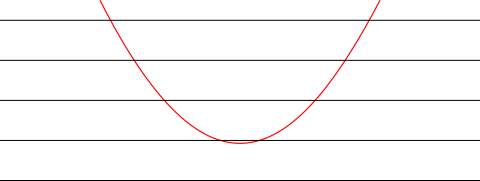
In the to a higher place picture, if Klipper is requested to move along the ruby line and if each black line represents the nominal location to step a stepper, so in the middle of that move Klipper will arrange to take a step, change the step direction, and so step back. Klipper can perform this step, direction alter, and footstep back in a very small amount of fourth dimension.
It is our current agreement that the TMC2208 and TMC2224 will react poorly to this when they are in "stealthchop" mode. (It is not believed any other TMC drivers are impacted.) Information technology is believed that when the driver sees the two stride requests in a small fourth dimension frame that it dramatically increases current in apprehension of high acceleration. That high electric current can trip the driver'south internal "over current" detection which causes the driver to disable itself.
This blueprint of steps can occur on all stepper motors and on all robot kinematics.
The TMC2208 and TMC2224 practise piece of work well with Klipper when run-time configuration mode is used (that is, when a wire is routed from the micro-controller to the PDN-UART pin and the printer config file has a corresponding [tmc2208] config section). When using run-time configuration, either configure the drivers to use "spreadcycle mode" or configure them to use "stealthchop mode" with a reasonable "stealthchop threshold". If 1 wishes to exclusively use "stealthchop" mode with run-fourth dimension UART configuration then make sure the stealthchop_threshold is no more than about 10% greater than the maximum velocity of the given centrality. It is speculated that with a reasonable stealthchop threshold, and then if Klipper sends a "stride, direction change, step back" sequence, the driver will briefly transition from stealthchop fashion, to spreadcycle mode, and back to stealthchop style, which should be harmless.
I keep getting random "Lost communication with MCU" errors
This is ordinarily caused past hardware errors on the USB connection between the host machine and the micro-controller. Things to look for:
- Apply a good quality USB cable between the host motorcar and micro-controller. Make sure the plugs are secure.
- If using a Raspberry Pi, use a skilful quality power supply for the Raspberry Pi and utilize a good quality USB cable to connect that power supply to the Pi. If you become "nether voltage" warnings from OctoPrint, this is related to the power supply and it must be fixed.
- Brand certain the printer'south power supply is not being overloaded. (Power fluctuations to the micro-controller's USB chip may event in resets of that chip.)
- Verify stepper, heater, and other printer wires are not crimped or frayed. (Printer motion may place stress on a faulty wire causing information technology to lose contact, briefly brusque, or generate excessive noise.)
- There have been reports of high USB noise when both the printer's power supply and the host'south 5V ability supply are mixed. (If you notice that the micro-controller powers on when either the printer's power supply is on or the USB cable is plugged in, then it indicates the 5V ability supplies are beingness mixed.) Information technology may assist to configure the micro-controller to employ power from only one source. (Alternatively, if the micro-controller lath can not configure its power source, one may change a USB cable so that it does not carry 5V power between the host and micro-controller.)
My Raspberry Pi keeps rebooting during prints
This is most likely do to voltage fluctuations. Follow the same troubleshooting steps for a "Lost advice with MCU" fault.
When I prepare "restart_method=command" my AVR device just hangs on a restart
Some old versions of the AVR bootloader have a known problems in watchdog result handling. This typically manifests when the printer.cfg file has restart_method set to "command". When the bug occurs, the AVR device will exist unresponsive until ability is removed and reapplied to the device (the power or status LEDs may also blink repeatedly until the power is removed).
The workaround is to utilize a restart_method other than "command" or to flash an updated bootloader to the AVR device. Flashing a new bootloader is a one fourth dimension step that typically requires an external programmer - run into Bootloaders for further details.
Will the heaters be left on if the Raspberry Pi crashes?
The software has been designed to foreclose that. In one case the host enables a heater, the host software needs to confirm that enablement every 5 seconds. If the micro-controller does not receive a confirmation every v seconds it goes into a "shutdown" state which is designed to plow off all heaters and stepper motors.
See the "config_digital_out" control in the MCU commands certificate for farther details.
In improver, the micro-controller software is configured with a minimum and maximum temperature range for each heater at startup (see the min_temp and max_temp parameters in the example.cfg file for details). If the micro-controller detects that the temperature is outside of that range and so information technology will also enter a "shutdown" state.
Separately, the host software likewise implements code to bank check that heaters and temperature sensors are performance correctly. See the "verify_heater" department of the instance-extras.cfg for farther details.
How practise I catechumen a Marlin pin number to a Klipper pin name?
Short answer: In some cases i can use Klipper's pin_map: arduino feature. Otherwise, for "digital" pins, one method is to search for the requested pin in Marlin'southward fastio header files. The Atmega2560 and Atmega1280 chips use fastio_1280.h, while the Atmega644p and Atmega1284p chips utilise fastio_644.h. For case, if you lot are looking to translate Marlin's digital pin number 23 on an atmega2560 then one could observe the following line in Marlin'southward fastio_1280.h file:
The DIO23 indicates the line is for Marlin's pin 23 and the PINA1 indicates the pin uses the hardware proper noun of PA1. Klipper uses the hardware names (eg, PA1).
Long respond: Klipper uses the standard pin names defined by the micro-controller. On the Atmega chips these hardware pins have names similar PA4, PC7, or PD2.
Long ago, the Arduino project decided to avoid using the standard hardware names in favor of their own pin names based on incrementing numbers - these Arduino names generally await like D23 or A14. This was an unfortunate pick that has lead to a great deal of confusion. In item the Arduino pin numbers frequently don't translate to the same hardware names. For example, D21 is PD0 on i mutual Arduino board, but is PC7 on another mutual Arduino board.
In order to support 3d printers based on real Arduino boards, Klipper supports the Arduino pin aliases. This characteristic is enabled past adding pin_map: arduino to the [mcu] section of the config file. When these aliases are enabled, Klipper understands pin names that outset with the prefix "ar" (eg, Arduino pin D23 is Klipper allonym ar23) and the prefix "analog" (eg, Arduino pin A14 is Klipper alias analog14). Klipper does not employ the Arduino names straight considering nosotros feel a proper noun like D7 is besides easily confused with the hardware name PD7.
Marlin primarily follows the Arduino pivot numbering scheme. However, Marlin supports a few fries that Arduino does not back up and in some cases information technology supports pins that Arduino boards do not expose. In these cases, Marlin chose their own pin numbering scheme. Klipper does non support these custom pin numbers - bank check Marlin'due south fastio headers (meet above) to translate these pivot numbers to their standard hardware names.
How do I cancel an M109/M190 "wait for temperature" request?
Navigate to the OctoPrint terminal tab and event an M112 command in the terminal box. The M112 command will cause Klipper to enter into a "shutdown" land, and it will crusade OctoPrint to disconnect from Klipper. Navigate to the OctoPrint connection area and click on "Connect" to crusade OctoPrint to reconnect. Navigate dorsum to the terminal tab and issue a FIRMWARE_RESTART command to clear the Klipper error state. After completing this sequence, the previous heating request will be canceled and a new print may be started.
How do I upgrade to the latest software?
The general way to upgrade is to ssh into the Raspberry Pi and run:
cd ~/klipper git pull ~/klipper/scripts/install-octopi.sh Then one can recompile and flash the micro-controller code. For example:
make menuconfig make clean make sudo service klipper stop brand flash FLASH_DEVICE=/dev/ttyACM0 sudo service klipper start However, it'due south often the case that only the host software changes. In this case, one can update and restart just the host software with:
cd ~/klipper git pull sudo service klipper restart If later on using this shortcut the software warns about needing to reflash the micro-controller or some other unusual error occurs, and so follow the full upgrade steps outlined to a higher place. Note that the RESTART and FIRMWARE_RESTART 1000-code commands do non load new software - the above "sudo service klipper restart" and "make wink" commands are needed for a software modify to take effect.
When upgrading the software, be sure to check the config changes document for data on software changes that may crave updates to your printer.cfg file.
Can I find out whether the printer has lost steps?
In a way, yeah. Home the printer, issue a GET_POSITION command, run your impress, home over again and issue some other GET_POSITION. Then compare the values in the mcu: line.
This might be helpful to tune settings like stepper motor currents, accelerations and speeds without needing to actually print something and waste filament: only run some loftier-speed moves in between the GET_POSITION commands.
Annotation that endstop switches themselves tend to trigger at slightly different positions, then a deviation of a couple of microsteps is likely the result of endstop inaccuracies. A stepper motor itself can only lose steps in increments of 4 full steps. (So, if one is using xvi microsteps, then a lost stride on the stepper would event in the "mcu:" step counter being off past a multiple of 64 microsteps.)

Source: https://mmone.github.io/klipper/FAQ.html
Posted by: williamsfixer1954.blogspot.com
0 Response to "How To Clean Mini Dv Head Without Tape"
Post a Comment